More Renters Concerned With Rising Utility Costs Than Rent Costs
October 16, 2025
How Electric Submetering Will Transform Property Operations in 2026
December 4, 2025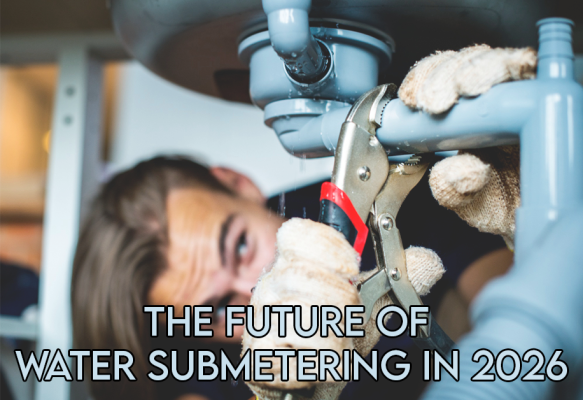
The Future of Water Submetering in 2026
As water scarcity, infrastructure strain, and operating costs continue to escalate, the water-submetering sector is entering a defining period. By 2026, property owners, operators, and utility stakeholders will increasingly view submetering not simply as a billing mechanism, but as a strategic asset supporting sustainability goals, regulatory compliance, and long-term financial performance.
Industry analysts forecast strong momentum for water-metering modernization through the remainder of the decade, driven by rising demand for real-time consumption data and the growing economic burden of leak-related losses. Against this backdrop, water submetering is poised to play an essential role in the next generation of multifamily, mixed-use, and commercial property management.
A Market Moving Toward Intelligence and Automation
The expansion of smart-metering infrastructure is accelerating submetering adoption across North America. Falling hardware costs, maturing AMI (Advanced Metering Infrastructure) networks, and expanding retrofit options are lowering the barrier to entry for owners who previously faced budgetary or logistical constraints.
In 2026, the market will be defined by:
Higher deployment of LoRaWAN, NB-IoT, and cellular endpoints that deliver near-real-time usage data with significantly reduced maintenance requirements.
Edge-based analytics capable of detecting leaks, abnormal usage patterns, and continuous flow events in hours rather than billing cycles.
Interoperable platforms designed to integrate with utility billing systems, property-management software, and ESG reporting tools.
This technological maturation is shifting submetering from reactive cost recovery to proactive asset management.

Regulatory Pressure Remains a Key Catalyst
Policymakers are sharpening their focus on water transparency and conservation, prompting new rules surrounding tenant billing practices, meter accuracy, and reporting requirements. Jurisdictions such as California, parts of the Northeast, and several urban municipalities are considering updated standards that may further incentivize submetering in new construction and substantial rehabilitation.
For property owners, the regulatory landscape presents both opportunity and risk. Compliance demands—particularly in markets with tenant protections tied to utility billing—require disciplined implementation and documentation. Companies operating across multiple states will increasingly adopt region-specific policies to ensure billing accuracy and consumer transparency.
Financial and Operational Impacts for Owners
For building operators and asset managers, the business case for submetering continues to strengthen.
Key drivers include:
More precise cost allocation, reducing the financial burden of shared utilities and aligning expenses directly with consumption.
Reduced water loss, thanks to early-warning systems capable of identifying leaks in individual units before they escalate into major claims.
Improved NOI, as owners move away from flat water-inclusion models and recapture previously unbillable usage.
Enhanced sustainability reporting, supported by granular consumption analytics that align with modern ESG frameworks.
However, challenges remain. Retrofitting older buildings can involve high upfront costs, particularly when plumbing access is limited. Additionally, as data flows grow more robust, cybersecurity will become a higher-stakes consideration for owners and vendors alike.
Where the Sector Is Heading in 2026
Looking forward, several trends are expected to shape the industry:
1. Service-Based Submetering Agreements
More providers are offering “submetering-as-a-service,” bundling hardware, reads, analytics, and billing into predictable monthly operating expenses—an attractive model for owners seeking to avoid capital outlays.
2. Consumer Transparency Tools
Tenant dashboards, automated alerts, and conservation insights will become standard expectations rather than value-added features.
3. Integration into Portfolio-Wide Water Strategies
Owners managing large portfolios are increasingly treating water consumption data as a critical component of risk management, insurance planning, and long-term infrastructure forecasting.
4. Expansion of Pre-Billing and Real-Time Notification Models
Some markets are experimenting with prepay systems, threshold alerts, and consumption caps—innovations that mirror energy-sector modernization.
Preparing for the 2026 Shift: Strategic Considerations
Executives and managers evaluating the move toward submetering should prioritize:
Comprehensive building-level audits to identify installation or retrofit complexities.
Vendor selection frameworks emphasizing interoperability, data security, and scalable communication technologies.
Standardized tenant-communication plans that promote clarity, trust, and compliance.
Pilot deployments to test operational impact before portfolio-wide rollout.
Regulatory diligence, ensuring billing practices align with local statutes and consumer-protection requirements.
Conclusion: Submetering Becomes a Strategic Imperative
By 2026, water submetering will no longer play a supporting role in property operations—it will sit at the intersection of financial performance, environmental responsibility, and regulatory compliance. Organizations that invest today in modern systems, analytics, and best-practice billing frameworks will be positioned to capture the economic and operational advantages emerging across the sector.